Water heaters
Water heater repair and replacement in Gresham
Most water heater calls start with cold water, a puddle or a strange noise. Whether to repair or replace depends on what failed and how old the tank is. Here is how to tell, and what to settle before anyone starts.
Right now
If the tank is leaking
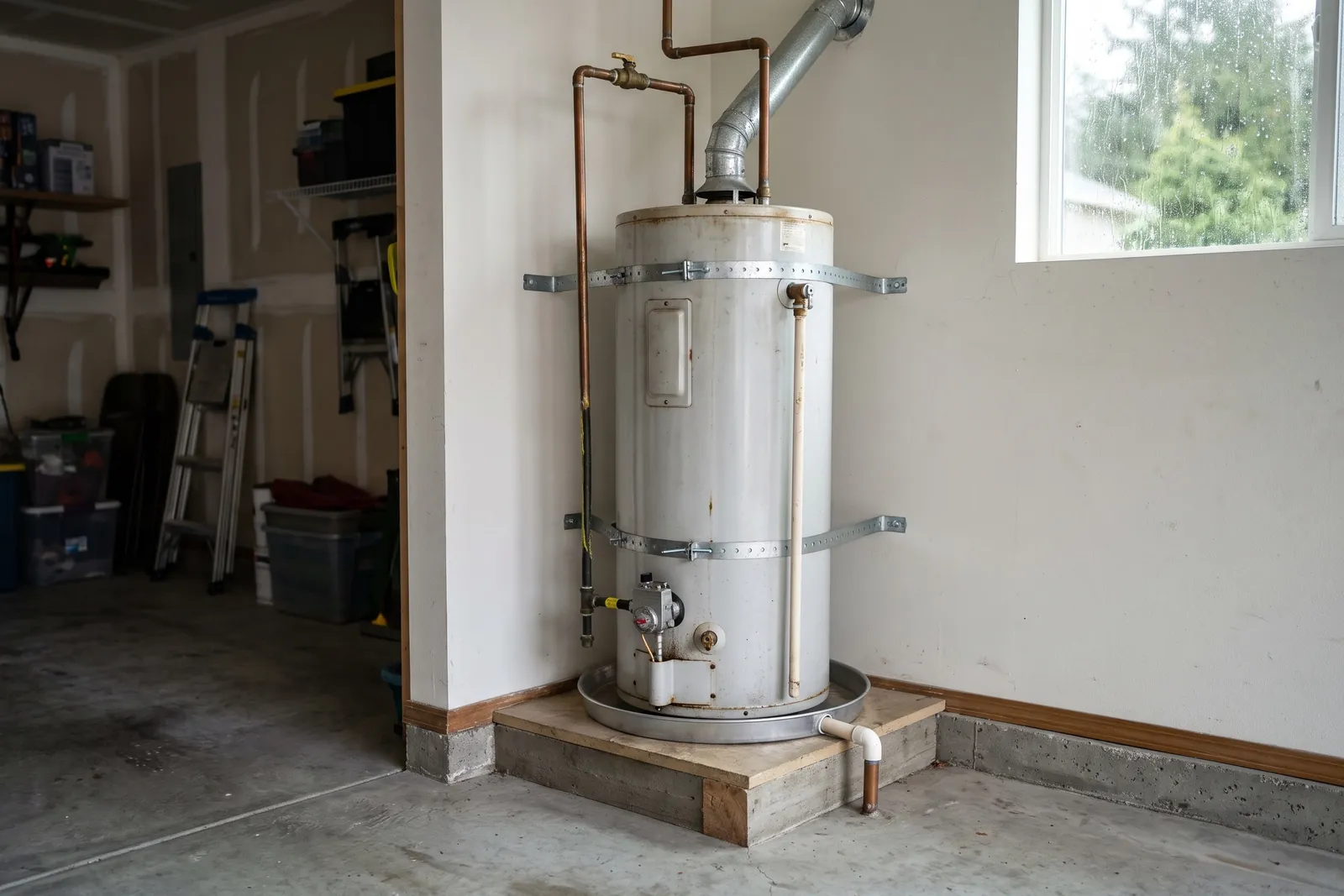
Close the cold water valve on the pipe going into the top of the heater. That stops the tank refilling. Then turn the heater off: on a gas unit set the control to pilot or off; on an electric unit switch off its breaker. An electric tank heated with no water in it burns out its elements.
Water from the top fittings or the relief valve pipe can sometimes be fixed. Water from the bottom seam or from under the tank jacket almost always means the steel tank has rusted through, and that tank can't be repaired.
What it's doing, and what usually causes it
No hot water at all
Gas: the pilot or igniter, thermocouple or gas valve. Electric: a tripped breaker, a high-limit switch or a failed element.
Right now Check the breaker or whether the pilot is lit. Don't relight it if you smell gas.
What to askHot water runs out fast
On electric tanks, often one of the two elements has failed. On any tank, sediment can fill the bottom and take up space.
Right now Note how long a shower lasts. The plumber will ask.
Repair or replacePopping or rumbling
Mineral scale on the bottom of the tank with water trapped under it, boiling in small bursts.
Right now Not urgent on its own. Ask about flushing the tank.
Repair or replaceRusty hot water only
The anode rod is used up, or the tank lining is going.
Right now Run cold only. If the cold is clear, the heater is the source.
What to askWater at the relief valve pipe
The temperature and pressure relief valve is letting go. It can be a worn valve or pressure building when the water heats.
Right now Never cap or plug that pipe.
Expansion tanks
The decision
Repair or replace?
Parts outside the tank, such as thermostats, elements, igniters, gas valves and relief valves, can be swapped. Once the tank itself leaks, only replacement is left. In between is a judgement call on age: the date of manufacture is usually coded into the serial number on the label, and the plumber can read it.
A heater well into its working life that needs an expensive control is often replaced rather than repaired, because the tank is the next thing to go. Ask the plumber to tell you both options and what each one leaves you with, then decide.
Tank or tankless?
Replacing like for like is the simplest job. Switching type changes more of the house.
Another tank
- Same size and fuel usually fits the existing pipes, vent and space.
- Hot water in reserve when power or gas flow is limited.
- Gas tanks need a working vent; the plumber checks the old one fits the new heater.
Tankless
- Heats as water flows, so it doesn't run out, but flow is limited by its size.
- Gas units often need a larger gas line and a new vent route through the wall or roof.
- Electric units can need a much bigger electrical supply. Ask whether your panel can take it.
- Needs periodic descaling. Gresham's groundwater can leave mineral scale over time.
Gresham rules
The permit for a new water heater
Gresham's permit FAQ says Oregon law requires a plumbing permit for a water heater, because a badly fitted one can cause fire, shock or an explosion. The city's residential plumbing permit form has its own line for a like-for-like replacement, and it says a permit won't be processed without a valid CCB number for the contractor.
So the company that fits your heater normally takes out the permit and arranges the inspection. Some licensed companies use the state's plumbing minor label program for certain small installations instead, which includes an inspection. Either way, ask which they will use and when the inspector will come. The permit has to be on site for the inspector, and an inspector can't pass work they can't see.
If you own and live in the house you may do the work yourself under a permit. Gresham's building permit FAQ has the details.
Expansion tanks and the backflow device at the meter
Water grows in volume as it heats. In an open system the extra pressure pushes back into the city main. Where a backflow prevention device or check valve is fitted at the meter, it can't, and pressure in the house climbs every time the heater runs. Fairview's water department tells its customers they may need thermal expansion protection when a backflow device goes in at the meter.
If your relief valve drips after each heating cycle, mention it on the call. A small expansion tank on the cold supply is the usual answer, and it's cheaper to fit while the heater is being replaced.
On the phone
Questions to settle before work starts
- What exactly failed, and can that part be replaced on its own?
- If replacing: what size, fuel and type, and why that size for this house?
- Does the price include the permit, haul-away of the old tank, any new vent, gas or electrical work, and an expansion tank?
- Who takes out the permit or minor label, and who meets the inspector?
- What written warranty comes with the heater from its maker, and what does the company cover on its own labour?
- Can I have the price, the work and the CCB number written down before you begin?
Water heater questions
My gas water heater pilot keeps going out. Can I keep relighting it?
A pilot that won't stay lit usually points to a worn thermocouple or a draft problem. Relighting it once by the label instructions is fine. If it keeps going out, or you smell gas at any time, stop, leave the area and call the gas company.
Does a tankless heater need its own permit in Gresham?
Yes. It is a water heater, and changing type usually also means gas or venting changes that a plumbing or mechanical inspector will want to see. Ask the company which permits they will pull.
How do I drain sediment from my tank?
The heater's manual explains flushing through the drain valve at the bottom. On an old tank that valve can stick or leak once opened, so if it hasn't been touched in years, ask a plumber to do it.
Cold shower this morning?
Call, say whether the heater is gas or electric, roughly how old it is and what it is doing. The plumber can tell you whether it sounds like a part or a tank.
Ready to describe the problem?
Say what is happening and where. You speak with an independent local plumbing company and decide with them what happens next.
Call (503) 555-0138Calls may be recorded. See how this referral is paid for and the privacy policy.